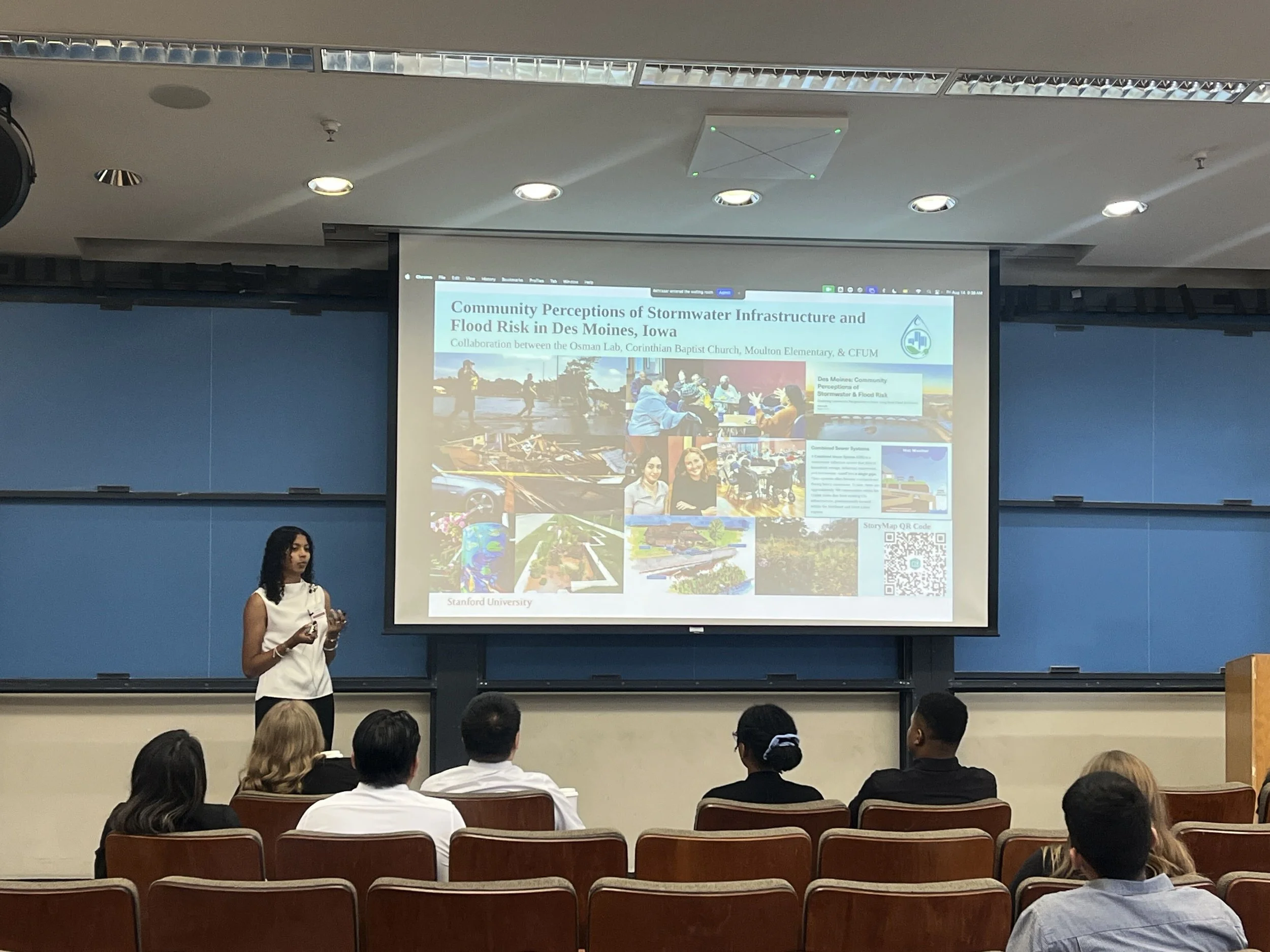
This summer, I had the opportunity to intern with the Osman Lab and develop an ArcGIS StoryMap for residents in Des Moines, Iowa. The StoryMap is a product of a much larger collaborative research project between Stanford, Iowa State University, University of Houston, and the Des Moines Metropolitan Wastewater Reclamation Authority. The overarching research project seeks to understand the impact of Combined Sewer Systems on marginalized populations and how modeling can be used to improve urban water systems. The ArcGIS StoryMap serves as an educational resource, designed to both inform Des Moines residents about the present condition of their water infrastructure and to share community perspectives of flooding and stormwater systems.
Des Moines is uniquely positioned as the fastest growing metropolitan city in the Midwest. However, city water infrastructure is failing to accommodate for the increasing demands of the rising population. In 2018, the city experienced historic flash floods, resulting in hundreds of damaged vehicles, over 1,800 affected homes, and one death. As climate change continues to disrupt precipitation patterns, Des Moines is becoming increasingly susceptible to flash flooding events putting already vulnerable community members at exacerbated risks.
The ArcGIS StoryMap, accessible here, serves to educate residents in Des Moines about their local water and wastewater systems. The StoryMap is filled with interactive images, detailed infographics, results from a community-wide survey, and an extensive resources section that redirects residents to city webpages with additional information. Featured topics include combined sewer overflows, water quality, community health, greenstormwater infrastructure, watershed protection, rainscaping, and local community initiatives that residents can get involved with. The StoryMap functions under the assumption that well-informed residents are more likely to become engaged with community advocacy and city planning initiatives. Centering community knowledge and building community capacity is the first step towards fostering cross-collaborative approaches and restoring trust with the Des Moines water/governmental authorities.
I am extremely grateful for Arianna Bordogna-Jurkowitz, Samuel Camacho, and Dr. Osman for their guidance on this project. Interning with the Osman Lab has encouraged me to think critically about how engineering can be used as a tool for public good. Community engaged approaches are vital for ensuring that community voices are heard and valued in the entire research process. Please visit the StoryMap to learn more about the story of Des Moines!